Why Kenektic Is Built on Claude (Not With "Vibe Coding" Do-It-All Platforms)
I built two apps in two hours. Then I tried to build a company. That's where things got interesting.
A few weeks into building Kenektic, I was curious about the "vibe coding" platforms everyone was talking about — Replit, Lovable, Bolt, and others. Tools that let you describe what you want in plain English and get a working app back in minutes. No coding required. No terminal. No VS Code. Just type what you want and watch it appear.
So I tried them.
I used Replit to build an app called FanCal. You select your favorite sports teams from leagues around the world, and it puts every game into a calendar view — daily, weekly, however you want to see it. It also exports to iCalendar, so you can create a group in your phone's calendar just for sports and toggle it on and off. I built it in about an hour.
Then I used Lovable to build a hex color tool. You browse and sample colors, see the hex codes, and compare them side by side. I used it to pick every color you see on the Kenektic website. Another hour, start to finish.
Both tools were amazing for what they do — helping someone with no coding background build a simple, personal app. If you want to check out FanCal or the hex finder, they're both free on my GitHub.
But here's the thing. Could I build Kenektic with them?
No way. Not even close.
The Line Between an App and a Company
There's a difference between building an app and building a company's technology. An app does one thing. It has a screen, some buttons, maybe a database behind it. It doesn't need to handle thousands of simultaneous conversations with an AI companion. It doesn't need to extract someone's personality from a chat in real time. It doesn't need to match lonely people with compatible friends using algorithms that weigh dozens of psychological dimensions. It doesn't need real-time messaging, vector databases for semantic search, enterprise-grade authentication, or an AI that gets smarter with every interaction.
Kenektic needs all of that. And the only way to build it was using large language models directly — inside VS Code, connected through APIs, with full control over every piece of the architecture.
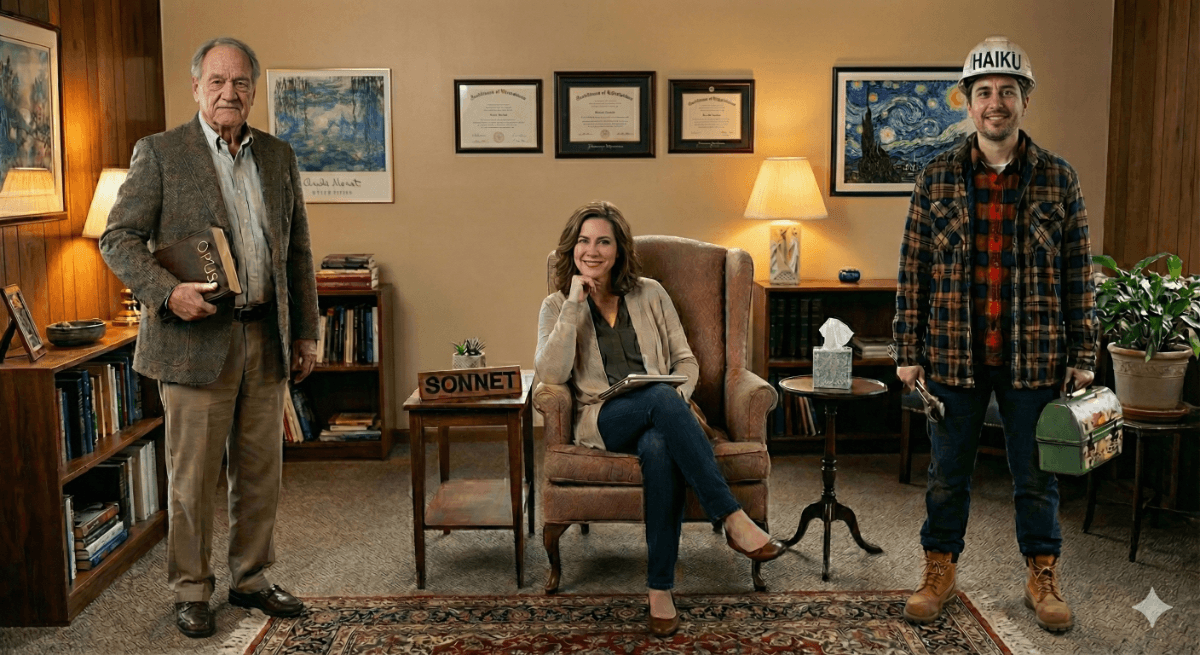
Which brings me to the thing I want to explain today: why Kenektic isn't just built with Claude. It's built on Claude. Three different Claude models, each doing what it does best, working together as the brain of the entire platform.
The PhD, the Psychologist, and the Workhorse
When I started this journey, I thought "Claude" was one thing. One AI. One model. But Anthropic built something much smarter than that. They built a family of models — Opus, Sonnet, and Haiku — each designed for fundamentally different jobs. And understanding the difference between them became one of the most important things I learned.
Opus is the PhD.
Claude Opus built every single line of Kenektic's code with me. Every feature, every system, every architectural decision. Working with Opus is like having the best software engineers in the world sitting next to you — the kind who don't just write code but think about code. They understand the whole system. They anticipate problems three steps ahead. They architect solutions that scale.
Opus is the reason a guy with no coding background could build a production platform with twenty-five thousand lines of TypeScript, nine hundred automated tests, and an AI architecture sophisticated enough to impress actual engineers. It's expensive — the most expensive model in the family — but when you're building the foundation of a company, you want the PhD in the room.
Sonnet is the psychologist.
Here's the thing about PhDs — they're brilliant at complex reasoning, but they're not always the best at sitting across from someone and having a deeply personal conversation about why they feel alone.
That's Sonnet's job. Claude Sonnet is the engine behind every conversation kAI has with a user. When someone tells kAI about losing their spouse, or about being the new kid at college who hasn't made a single friend, or about sitting in an office surrounded by colleagues and still feeling invisible — Sonnet handles that conversation with emotional intelligence that consistently surprises me.
Sonnet became the psychologist of the company. Not literally — kAI isn't therapy, and it's careful about that boundary. But Sonnet is the model that turns two thousand lines of personality guidelines into actual empathy. It reads the room. It adjusts its tone for a Gen Z college student differently than for a Boomer retiree. It knows when to push deeper and when to gently redirect. It handles trauma with care. It keeps every conversation focused on what kAI is actually there to do: be your friend, and introduce you to real friends.
Haiku is the workhorse.
Haiku isn't as smart as Opus at coding. It isn't as emotionally nuanced as Sonnet in conversation. But Haiku does something neither of them can do: it runs fast. Really fast. And it does it for a fraction of the cost.
Every time you talk to kAI, there's a whole world of intelligence running behind the scenes that you never see. Haiku is doing all of it.
It's extracting your personality traits from the conversation — not with a questionnaire, but by listening to how you actually talk and what you actually say. It's identifying your interests and rating how strongly you feel about each one. It's building your loneliness profile — understanding not just that you're lonely, but why, and what kind of connection you're actually seeking. It's cataloging the important people in your life, your pets, the topics you keep coming back to. It's generating your bio from what it's learned. It's processing research documents so kAI can cite actual studies when you ask about loneliness. It's creating conversation summaries. It's figuring out the best ice breakers when two matched users start talking.
All of that runs on Haiku. All of it happens in the background while Sonnet is having the conversation you can see. And because Haiku is optimized for speed and efficiency, it all happens fast enough that you'd never know it was there.
Why Three Models Matter
The pricing tells part of the story. Per million tokens — which is the way AI companies charge for usage — Opus costs $5 in and $25 out. Sonnet costs $3 in and $15 out. Haiku costs $1 in and $5 out. If I ran everything on Sonnet, the platform's operating costs would triple. If I ran everything on Opus, they'd multiply by five. And it would actually be worse — slower for background tasks, overkill for extraction work, and more expensive for the things that don't need that level of intelligence.
But cost isn't even the main reason. The main reason is that each model is genuinely better at its specific job than the others would be.
Opus is better at understanding my entire codebase and writing sophisticated code than Sonnet would be. Sonnet is better at navigating a sensitive conversation about loneliness than Opus would be. And Haiku is better at rapidly extracting structured data from a conversation than either of them — not because it's smarter, but because it's built to be fast and focused.
Anthropic didn't build three sizes of the same thing. They built three different tools for three different jobs. And figuring out which tool to use where was one of the most important architectural decisions I made.
The API Moment
I want to pause and tell you about the moment this all clicked, because it matters for anyone reading this who thinks building AI into a product is some mystical, unreachable skill.
In my previous life in financial services, I'd hear the IT team talk about "APIs" — application programming interfaces — like they were speaking a different language. APIs were how systems connected to each other. NetSuite talked to the CRM through an API. The trading platform talked to the risk engine through an API. It sounded incredibly complex. Something only serious engineers touched.
Then I learned how to use them with Claude. And I realized that what used to be a deeply technical skill had become remarkably accessible. I could connect Anthropic's AI models directly into Kenektic through their API — sending user messages to Sonnet, receiving responses back, processing data through Haiku — all with code that Claude helped me write and that I actually understood.
That's the thing nobody tells you about building with AI in 2025. The hard part isn't the API. The hard part is knowing what to build and how to architect it. The connection itself? Claude made that easy.
What Vibe Coding Can't Do
Let me come back to FanCal and my hex color tool.
After I built the hex finder in Lovable, I actually opened it in VS Code and had Opus help me add something the vibe coding platform couldn't: AI-powered color conversion. Standard tools can convert a hex code from RGB to CMYK — that's just math. But anyone who's ever printed a presentation knows that colors look different on screen than on paper. The ink sinks into the paper, the colors wash out, and that beautiful blue from your monitor comes out looking like a sad gray.
My tool uses AI to predict how much the ink will absorb and adjusts the CMYK values to compensate. So what you print actually looks like what you designed. It's a small thing, but it's a perfect example of the line between what vibe coding can do and what you need real AI integration to accomplish.
Scale that up by a thousand and you get Kenektic. Vector databases storing semantic embeddings. Real-time WebSocket messaging. Row-level security in PostgreSQL. A multi-model AI architecture where three different Claude models coordinate across dozens of API endpoints. Automated testing with nine hundred tests. CI/CD pipelines. Server-side streaming for kAI responses.
None of that fits inside a "type what you want and we'll build it" platform. It's not a criticism of those tools — they're great for what they are. But building a company's technology requires building it the real way. With an LLM in your terminal, inside your code editor, with full control over every line.
Breaking Things (Like Real Coders Do)
I want to be honest about something, because this post would feel like an advertisement if I didn't say it: Claude breaks things.
All the models do, sometimes. Opus will write code that introduces a bug in a feature that was working fine yesterday. Sonnet will occasionally miss a nuance in a conversation. Haiku will extract data that isn't quite right.
But here's what I've learned — that's not a bug in the system. That's how coding works. Human developers break things too. Every single one of them. The difference isn't whether things break. The difference is whether you catch it and fix it.
And this is where the whole system comes together. Remember the Comprehensive Review document I talked about a few weeks ago? The one that grades every component of the platform? That document catches Claude's mistakes. Every time we update the project documents, Claude reviews its own work, finds issues it introduced, flags them, and then fixes them. It's a self-correcting system. The PhD builds it, the psychologist runs the conversations, the workhorse handles the background — and the Comprehensive Review keeps all of them honest.
What Comes Next
Kenektic is built on Claude. Not with a vibe coding platform. Not with a chatbot wrapper. With three AI models working together — the PhD writing the code, the psychologist running the conversations, the workhorse handling everything you don't see — connected through APIs that a finance guy learned to use in a matter of weeks.
Next week, I'm going to tell you about the document that changed how I understood my own platform. When Kenektic got complex enough that I couldn't hold it all in my head, I sat down and wrote the Owner's Manual — a single document that captured everything about how the platform worked. It forced me to understand what I'd built at a level I hadn't before. And it became the blueprint for everything that came after.
Have you experienced something similar? Whether you code professionally or you're just starting to explore AI tools — what's your setup? Are you using vibe coding platforms for quick projects? Building with LLMs directly? Still trying to figure out the difference? I'd genuinely love to hear your story.
Kenektic is in development and will launch soon. If you want to be notified when we're ready, or if you want to share your story with me directly, reach out at hello@kenektic.com.
Coming Next: "The Owner's Manual: Writing the Blueprint for Everything" — When the platform got too complex for my head, I wrote it all down. And that changed everything.