The Work Friends You Never Really Had
I had three friends at my wedding from work.
Three people I genuinely cared about. People I'd eaten lunch with, laughed with, stayed late with when deadlines hit. After I moved on from that job, I didn't keep in touch with a single one of them.
Not because something went wrong. Not because of a falling out. Just because — without the structure of the shared workplace keeping us in the same orbit — the friendships thinned and then disappeared. The way they always did for me.
I also had one friend from USC at my wedding, and my two best friends from high school. You know those stories by now. That's the math of my social life, laid out at the table assignments of my own wedding.
Thousands of People. No Close Friends.
Here's something I've never fully admitted before: I felt lonely at work my entire career.
Not always. Not every day. Work was actually easier for me than school in some ways — there was structure, shared purpose, built-in reasons to talk to people. For someone like me, who never figured out how to manufacture connection out of thin air, that scaffolding helped. I made friends at jobs in a way I never quite managed at Oregon or USC.
But "made friends" is doing a lot of work in that sentence.
The truth is, very few of those work friendships were ever substantial. I rarely saw anyone from work outside of work. I'm not sure most of the people I worked alongside ever knew the real me — they knew the work persona. The professional version. The guy who was good at his job, who could read a balance sheet and run a meeting and be pleasant in the break room. That guy.
But the real me — the person who ate lunch on a wall in seventh grade, who sat on a barstool at bars in Eugene waiting for his one friend to come back, who spent a lifetime struggling with the exact problem I'm now building a company to solve? That person rarely showed up at the office.
And when a friend left the job before me — when the colleague I'd actually connected with moved on to something else — I'd go right back to eating lunch alone. Because the friendship had been tethered to the structure. Without the daily proximity keeping it alive, I didn't know how to maintain it. I never did.
The Conference Circuit
For years, my career put me in a world where everyone knew everyone. Mortgage-backed securities is a small industry — same conferences, same panels, same cocktail hours, year after year. I knew dozens of people on that circuit. Hundreds, probably.
But here's the honest version of what "knowing" those people meant: we recognized each other. We'd nod across a hotel ballroom. We'd exchange business cards. We'd have perfectly pleasant conversations over rubber chicken at the awards dinner.
No close friends. Thousands of people — and no close friends.
Same wall. Better suits.
After 2008: The Final Accounting
When the financial crisis hit and we eventually sold what remained of the company, I did the math on the relationships I'd built across an entire career.
I kept in touch with three people: one employee I'd been genuinely close to, and two of my partners.
Today I'm not in touch with any of them.
I think about those people sometimes — the employees who were so much more than employees to me, the colleagues I cared about more than I ever quite showed. They're out there somewhere. And I'm just another former boss they probably don't think about much anymore.
For them, I'm a faded memory. For me, they're one more entry in the long list of people I didn't know how to hold onto.
That's my work friendship story. And I'm telling it because it's not unique.
According to Gallup, 80% of employees don't have a work best friend. Eighty percent. That's not a fringe group of socially awkward people like me — that's the overwhelming majority of the American workforce showing up every day to a place where they spend the majority of their waking hours, surrounded by people they'll never really know.
The Cigna 2023 Loneliness Index found that 52% of workers report feeling lonely — regularly. Not occasionally. Regularly. And among Gen Z workers, the generation that grew up more digitally connected than any before them? 73% say they feel lonely sometimes or always at work.
This is not a personal failing. This is a structural crisis.
What Killed the Work Friendship
There's a reason work friendships used to happen more organically, and a reason they're harder now.
Before remote and hybrid work became the norm, the office had what I'd call margin moments — the unscripted, unscheduled interactions that were the actual substrate of workplace friendship. The walk from the parking garage. The coffee line. The lunch table where you ended up next to someone from a different department. The walk-by conversation that started as "hey, did you see that email?" and somehow became a real exchange.
Nobody planned those moments. Nobody ran a workshop about them. They just happened, because everyone was in the same physical space at the same time, and proximity creates the conditions for connection.
Remote and hybrid work didn't just move people out of the office. It eliminated those margin moments entirely.
The COVID-19 pandemic accelerated a shift that's now permanent: 30% of work is now done remotely, compared to roughly 5% before 2020. Water cooler conversations — gone. Lunch room gatherings — gone. Hallway encounters — gone. New hires sometimes never meet their colleagues in person. Cross-department relationships that used to form in the break room now have no natural formation mechanism whatsoever.
The result is 67% higher loneliness among remote workers compared to their in-office counterparts.
But here's what I want you to notice: even before remote work became the dominant story, I was lonely at jobs where I sat thirty feet from my colleagues every single day. The office being nearby doesn't mean connection is happening. I'm living proof of that. The margin moments help — but for a lot of people, they were never enough.
What Companies Are Losing
I've spent most of my career in financial services, which means I think in numbers first. So let me tell you what the data says about what workplace loneliness actually costs.
$154 billion. That's the annual estimate for stress-related absenteeism in the U.S. attributed to loneliness. Not total absenteeism — just the loneliness-driven slice of it.
$15,000 to $25,000. That's the average cost to replace a single employee when you account for recruiting, onboarding, lost productivity during the transition, and the institutional knowledge that walks out the door. And lonely employees are significantly more likely to leave. The people who don't have a friend at work are the first ones to take a recruiter's call.
$7.8 trillion. That's what Gallup estimates is lost globally from disengaged workers every year. Loneliness and disengagement are not the same thing, but they're not independent either. An employee who feels invisible at work is not an employee who's bringing their full self to the job.
And on the other side of the ledger: employees who do have a work best friend are 7 times more engaged than those who don't (Gallup). Not marginally more engaged. Seven times. Connected employees have 50% lower turnover. Their healthcare costs are lower — lonely individuals have 32% higher healthcare costs overall.
The business case for workplace friendship isn't soft. It's one of the hardest numbers in the HR toolkit.
Why Everything Companies Try Doesn't Work
I've watched companies respond to this crisis with a predictable set of initiatives. I've participated in some of them. And I'll say this as gently as I can: they don't work.
Team building events are infrequent, feel forced, and their effects fade within days. The same people show up to the voluntary happy hours — the socially confident ones who didn't need the happy hour to begin with. Slack social channels see 5-15% engagement from employees who already know each other, performing friendliness for whoever's watching (and at most companies, senior leaders are watching). Mentorship programs focus on career development, not genuine connection. And random coffee chat programs — the "meet a stranger for 30 minutes" approach — are better than nothing, but they're not matching. They're just scheduling.
None of them solve the actual problem. None of them do the work of figuring out who you'd actually click with — not based on your department or your job level or the fact that you both showed up to the same optional event, but based on who you actually are.
That's the gap. That's where Kenektic for Teams lives.
What Actually Needs to Happen
The real problem has two parts, and you need to solve both or you haven't solved anything.
Discovery. Most employees never meet the colleagues they'd actually befriend — because those colleagues are in a different department, a different office, a different time zone, or just two floors up in a building where nobody takes the stairs. A developer in Austin and a finance person in New York will never end up at the same lunch table. They will never have a margin moment. And if they happen to have kids the same age, share the same obscure interest, and are both navigating the specific loneliness of being surrounded by colleagues and still feeling invisible — nobody is ever going to tell them they should talk.
Facilitation. Even when people discover each other — at a team event, through a shared Slack channel, in a meeting — converting that from "we've interacted" to "we're friends" requires something that most adults are terrible at asking for. It requires one person to say, essentially: "I'd like to know you better." Outside the structures that make that feel natural, most people won't do it. The ask feels too vulnerable. Too forward. Too much like it might be weird.
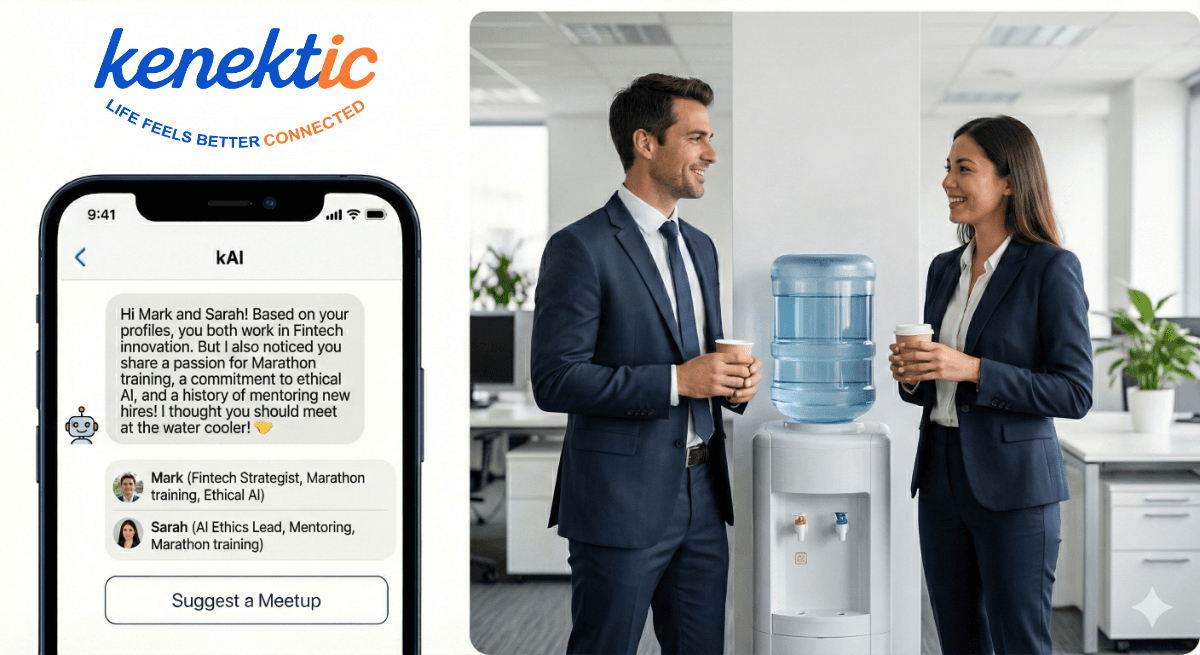
Kenektic for Teams solves both. kAI gets to know employees through natural conversation — learning who they actually are, not just their job title and department. Then it makes introductions across departmental and geographic lines that would never happen organically, with enough specific context that the first conversation isn't awkward. Not "meet this random colleague." "Here's why I think you two would actually get along."
The employer provides access. Every employee gets it — not the wellness-app version where 5% of people opt in and everyone else ignores it. Everyone. From day one.
And the employer never sees individual conversations or matches. Not ever. What they see is aggregate data: engagement rates, connectivity across departments, movement over time. The trust Kenektic requires from employees is built on a privacy architecture that earns it.
The Version of This I Wish Had Existed
When I think about my career — the colleagues who were more than colleagues to me, the people who drifted away when jobs changed, the employee I kept in touch with after 2008 and then eventually lost too — I don't think the problem was that we didn't care about each other.
I think the problem was that we were relying on proximity to do a job that proximity can't do alone. When the proximity disappeared, the friendship didn't have enough foundation to stand on its own.
What I needed — what most people in most workplaces need — wasn't a better happy hour. It was someone to say: "There are people here who would be your real friends if you could find each other. Let me help you find them."
That's what we built.
And the version of me who showed up to every job for three decades, working with good people, never knowing the real them and never letting them know the real me — he could have used it.
Have you experienced something similar? Do you have a work best friend? If you do — how did you find each other? If you don't — does the idea even feel realistic at this point? I'd genuinely love to hear your story.
Kenektic is in development and will launch soon. If you want to be notified when we're ready, or if you want to share your story with me directly, reach out at hello@kenektic.com.
Coming Next: "Loneliness Is Making Us Sick. Here's the Bill." — My health plan covers a lot. Loneliness isn't one of them. Why that needs to change — and why health plans are uniquely positioned to fix it.