The Pivot: Three Solutions That Changed Everything
I was building a spreadsheet when the idea hit me.
Not the fun kind of building — not coding, not designing, not teaching kAI how to be a better friend. The boring kind. Cash flow projections. Revenue forecasts. Personnel plans. The kind of spreadsheets I'd been building my entire career in financial services, except this time the numbers were supposed to tell me how Kenektic gets from here to profitability.
And the numbers were telling me something I didn't want to hear.
Customer acquisition for a consumer app is expensive. Really expensive. Every user you acquire costs money — marketing, ads, content, partnerships — and when your product is a free friendship platform, you're spending cash before you're making it. The path from launch to breakeven was longer than I wanted it to be, and the drain on cash flow was significant enough that I started doing what I always do when a problem feels too big: I started thinking about it from a completely different angle.
What if I didn't have to find lonely people one at a time?
The Communities Clue
The answer was hiding inside something I'd already built.
Kenektic's communities feature was designed to connect people around shared life circumstances — not just hobbies, but the deeper stuff. New parents feeling isolated. Cancer patients seeking peer support. Remote workers who hadn't made a real friend at work in years. LGBTQ+ individuals in areas where being out felt lonely. The communities were one of my favorite parts of the platform because they addressed a truth that most social networks ignore: loneliness isn't generic. It's specific. A college freshman who doesn't know anyone is lonely in a fundamentally different way than a retiree whose spouse just passed away.
As I was thinking about these communities, a question started forming: what if instead of waiting for individuals to find Kenektic on their own, I could bring Kenektic to entire groups of people who were already dealing with loneliness — together?
And then three ideas hit me in rapid succession.
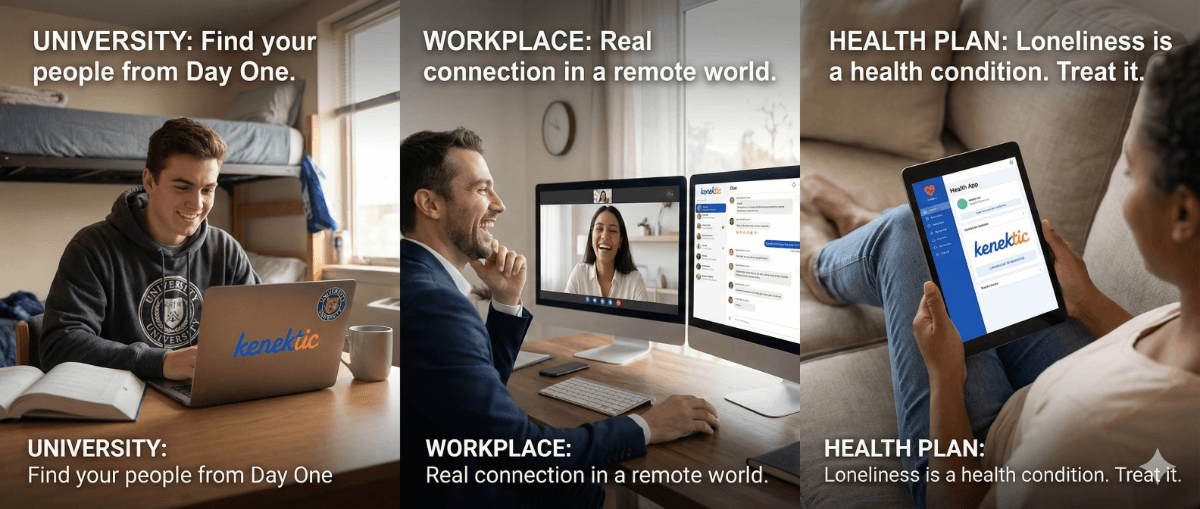
The University
The first thought was personal.
What would have helped me when I started at the University of Oregon? What would have helped my kids when they went to college? I was the kid on that wall in seventh grade, and I can tell you that showing up at a university where you don't know anyone feels a lot like seventh grade all over again — except now you're eighteen, you're supposed to be an adult, and there's no one making you go to the cafeteria.
What if every student at a university had access to kAI? Not as some optional wellness app buried in a student portal that nobody checks. As a real tool, provided by the university, that helps freshmen find friends before they even arrive on campus. An AI companion that learns who they are, understands what kind of people they'd click with, and introduces them to other students who are also looking for connection.
The student loneliness crisis is real and it's measurable. Universities are losing students — not because the education is bad, but because the students feel alone. And when a student drops out because they couldn't find their people, the university loses tuition, the student loses their trajectory, and everyone pretends it was about academics when it was really about belonging.
Kenektic could fix that. Not as a consumer app that a few students might stumble onto, but as a university-provided solution that every incoming student has access to from day one. I'll go deeper into the specifics in a future post, but the insight was immediate and visceral: I'd lived this problem. My kids had lived this problem. Millions of students are living it right now.
The Workplace
The second thought came from watching my friends.
I have friends who've been working remotely for years now, and almost all of them say the same thing: they have colleagues, but they don't have work friends. Not real ones. They hop on Zoom calls, they collaborate in Slack, they hit their deliverables — and then they close their laptops and feel completely disconnected from the people they spend eight hours a day "working with."
And it's not just remote workers. Even people in offices are feeling it. The water cooler conversations got shorter after COVID. The happy hours stopped being happy. Team building events feel forced because they are forced.
I started thinking about what Kenektic could do inside a company. Not as another HR initiative that everyone rolls their eyes at, but as a real connection tool. What if a developer working in Menlo Park could meet someone in finance working in New York — two people who would never cross paths in a meeting, never end up on the same Zoom call, never sit in the same cafeteria — but who kAI thinks could be each other's next work best friend?
Not because they're in the same department. Not because they're on the same project. Because they're actually compatible as humans. Because they both love hiking and have kids the same age and are dealing with the same weird feeling of being surrounded by colleagues and still feeling alone.
How much would that improve happiness in the workplace? How much would that improve retention? How much would a company pay to have their employees actually enjoy the people they work with?
The Health Plan
The third thought came from my own benefits statement.
I have amazing health benefits. Best I've ever had. But the coverage for mental healthcare is severely lacking — and I suspect my experience isn't unique.
In-network providers are covered at seventy-five percent. Great, in theory. But every time I called one, they weren't accepting new patients, or the information on the plan's website was outdated. Out-of-network coverage drops to twenty-five percent. So for every two-hundred-dollar therapy session, I'm paying a hundred and fifty out of pocket. And here's the thing — even if I could get in the door, traditional therapy doesn't specifically address loneliness. It's not designed to. A therapist can help you understand why you're lonely, but they can't introduce you to someone who might become your friend.
My health plan also gave me free access to a meditation app. I tried it. It was helpful for falling asleep. But beyond that? For me, it just didn't provide much else.
And that's when the health plan idea crystallized. What if Kenektic wasn't just a tech product but a health benefit? What if health plans covered access to kAI the same way they cover access to therapy or meditation apps — except this time, the tool was specifically designed to address the health condition that the Surgeon General called a public health crisis?
Loneliness isn't a mood. It's a health condition. It's linked to cardiovascular disease, cognitive decline, weakened immune function, and premature death. It's the equivalent of smoking fifteen cigarettes a day. And right now, the healthcare system's answer is "here's a meditation app and a list of therapists who aren't taking new patients."
Kenektic could be the answer that actually works. Not a replacement for therapy — an addition to it. A tool that doesn't just help you understand your loneliness but actively does something about it by connecting you with real people.
The Math Changed
Here's what got me really excited: the math.
When I plugged the three verticals into my financial models, everything changed. The revenue forecasts improved dramatically. The path to profitability shortened. The unit economics made sense in a way that the consumer-only model struggled to achieve.
Universities pay per student. Companies pay per employee. Health plans pay per member. These are B2B contracts with predictable revenue, lower customer acquisition costs, and built-in distribution. Instead of spending millions on marketing to acquire individual users, I could sign one university contract and bring Kenektic to ten thousand students overnight.
And the pitch deck — which had been good before — suddenly told a completely different story. This wasn't a consumer friendship app trying to compete with every social network on the planet. This was a platform that could serve people across their entire lives: as students, as employees, and as health plan members. The same technology. The same kAI. The same mission. Three different entry points that each solve a specific version of the same problem.
Everyone I shared this with agreed. The pivot made sense. The numbers supported it. The story was compelling.
But the best part — the part that made me want to build even faster — was what the three verticals made possible for the consumer app. Because if universities, companies, and health plans are generating enough revenue to sustain the business, that creates the financial foundation to pursue the goal that started this whole thing: offering this technology to anyone in the world who is feeling lonely. Making their lives happier, healthier, and more satisfying. Not behind a paywall. Not as a premium feature. As a tool that's available to every person who needs a friend.
The B2B verticals don't replace the consumer mission. They fund it.
What Comes Next
Over the next three weeks, I'm going to go deep on each of these verticals. What the student loneliness crisis actually looks like. Why workplace friendship is a business problem, not just a feel-good initiative. And why health plans should be covering loneliness solutions the same way they cover blood pressure medication.
Starting next week with universities — because that's where this all begins. Where every student gets a friend on day one.
Have you experienced something similar? At school? At work? In your health plan's hold queue waiting for a therapist who's not taking new patients? Loneliness shows up in different places for different people. Where does it show up for you? I'd genuinely love to hear your story.
Kenektic is in development and will launch soon. If you want to be notified when we're ready, or if you want to share your story with me directly, reach out at hello@kenektic.com.
Coming Next: "Why Kenektic Is for Universities First" — The student loneliness crisis is costing universities millions in lost tuition from dropouts. Here's how kAI could change that — starting with day one of freshman year.