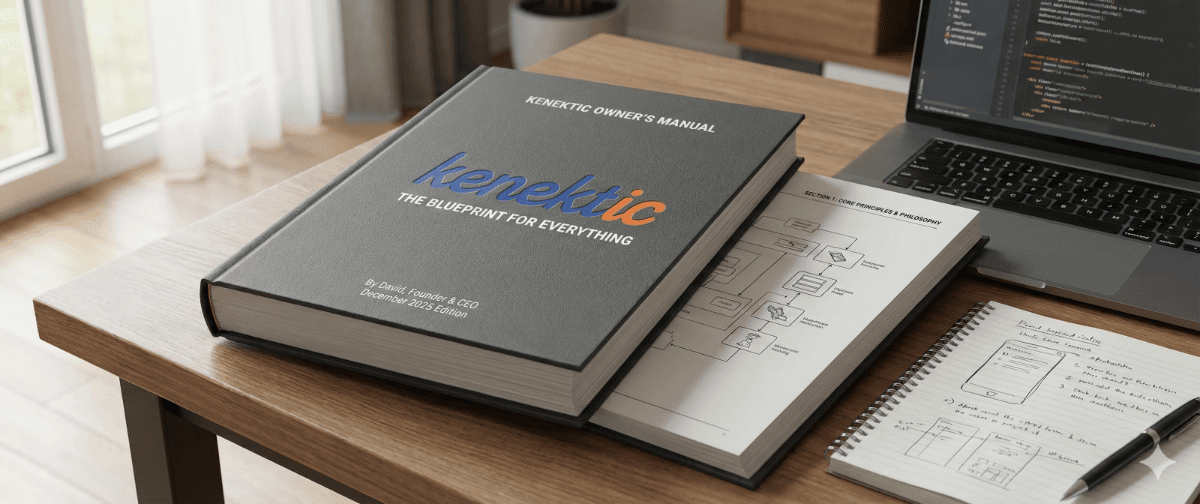
The Owner's Manual: Writing the Blueprint for Everything
I needed to prove to a stranger that what I'd built was real. So I wrote an owner's manual. And then the manual proved it to me.
Let me back up.
By late December 2025, I'd been building Kenektic for about two months. The platform was working. kAI was having real conversations. The matching algorithm was connecting people. The messaging system was running in real time. Communities were live. I had over five hundred automated tests confirming that the whole thing actually functioned.
But here's the problem with building something this fast using AI: you don't always stop to look at what you've done. You're in the tunnel. You're sprinting from feature to feature, version to version, and the only direction you're looking is forward. The Comprehensive Review tells you what's next. The Dashboard tells you what's done. But neither of them answers a different question — one that was starting to keep me up at night.
What would an investor see?
The Investor Question
I'd been thinking about fundraising. Not actively — I wasn't ready yet — but the question was always in the background. If someone wrote me a check, what would they want to see during due diligence? How would I show them that Kenektic wasn't just a chat window connected to an AI model?
A code review wouldn't do it. Code reviews are for engineers. An investor wants to understand what the product does, how the pieces fit together, and whether the founder actually knows what they've built. They want to open a document and see the whole picture — every feature, every system, every architectural decision — laid out in a way that makes sense.
So I decided to write it all down. Everything. I called it the Owner's Manual, because that's exactly what I wanted it to be: the document you'd hand someone who just bought the company and needed to understand how every part of it worked.
I told Claude what I wanted. Claude created it. And like everything else in our workflow — code, documents, strategy — we went back and forth until it was right. Claude would come up short, I'd push back, we'd refine, and eventually it started looking like what I had in my head.
What came out the other end was 1,389 lines of documentation covering every single aspect of the platform.
I was not prepared for what I saw.
The "How Did I Build This?" Moment
When the Owner's Manual was finished, I sat there staring at my screen with a very specific expression on my face. The kind of expression you make when you open your credit card statement after a vacation and the number is way higher than you expected — except in this case, it was a good thing.
How the hell did I build all this?
I'm not being dramatic. I genuinely did not realize the scope of what we'd created until I saw it written down in one place. It was way more than I was giving it credit for. When you're building every day, adding features, fixing bugs, moving to the next thing, you lose perspective. You forget that four weeks ago you built an entire matching algorithm. You forget that the AI companion you're chatting with every day is running on a system prompt assembled from nineteen different context components. You forget that there are forty-three database tables underneath this thing, all secured with row-level policies.
The manual reminded me.
What Was in the Manual
I won't bore you with every section — it was a technical document, and this is a blog post, not a bedtime story. But let me give you the highlights, because I think it matters for understanding what a solo founder with Claude can actually build.
The Philosophy. The manual opened with our core principles. Friendship over dating. No vanity metrics — no like counts, no follower counts, no trending posts, no engagement statistics. Chronological feeds with no algorithm deciding what you see. Quality connections over quantity. Privacy-first architecture. Identity verification. These weren't new — they'd been the foundation from the beginning. But seeing them written out in a formal document made them feel permanent. Non-negotiable. Every feature in the platform existed because it aligned with these values. If it didn't align, it didn't belong.
The Page-by-Page Guide. Every single screen in the application, documented. The home page. The kAI chat — how conversations actually work, step by step, from the moment you type a message to the moment kAI responds. The profile page that shows what kAI has learned about you. The matching system. Real-time messaging with typing indicators and WebSocket connections. The Memory Board — our anti-social-media social feed where you can see who reacted to your post but never how many people did. Communities built around life circumstances, not just hobbies, with privacy levels and verification systems for sensitive groups. Even Kenekt Four, our Connect Four game where the AI opponent uses a minimax algorithm with alpha-beta pruning. Yes, even the game had its own section.
Side note: I still can't beat the hard difficulty on Kenekt Four. The AI I built to play Connect Four is better at Connect Four than I am. Make of that what you will.
The kAI Deep Dive. This section documented how kAI's brain actually works. Every time you send a message, the system assembles a comprehensive prompt from nineteen different sources — your profile, your interests, your personality traits, your loneliness patterns, your connection goals, your family and pets, the topics you keep coming back to, your Memory Board posts, your community memberships, your generation, and a set of behavioral guidelines that tell kAI exactly how to be your friend. The Friend Balance Formula was in there: forty percent of responses should just share interesting information with no questions, fifty percent should share and ask one question, and ten percent should be strategic questions designed to understand you better. Maximum one question per response. Never interrogate. Lead with knowledge before asking. Be the smartest friend they know.
The Matching Algorithm. Four weighted components: interests at forty percent, what you're seeking in a connection at thirty percent, location at twenty percent, and lifestyle at ten percent. Each with its own scoring logic. Deal breakers that could tank a match score by thirty points. Location bonuses for people willing to travel. The whole formula, documented.
Forty-Three Database Tables. User tables. AI tables. Chat tables. Matching tables. Messaging tables. Memory Board tables. Community tables. All with row-level security policies ensuring users could only see their own data. I didn't know it was forty-three until Claude counted them.
Five Hundred and Twelve Tests. Unit tests, integration tests, end-to-end tests. The manual documented how the testing pipeline worked, how seed data was generated, and how the admin dashboard could spin up realistic test users with simulated conversations, extracted interests, and calculated matches.
What It Actually Became
Here's the thing I didn't expect. I started building the Owner's Manual as an investor document — something I could share during due diligence to show the platform was real. But it became something much more useful than that.
It became a mirror.
Not the kind that shows you what you look like. The kind that shows you what's missing. When you document every feature in your platform, you can't help but see the gaps. Sections that feel thin. Systems that are started but not finished. Areas where the vision is clear but the implementation hasn't caught up yet.
The manual didn't just show me how far I'd come. It showed me what was missing. Things I'd need later. Things that weren't urgent now but would be critical as the platform grew. It gave me a tool to measure not just what I'd done, but what still needed to happen — and whether the work ahead stayed in line with the values I'd defined upfront.
Those core principles at the top of the document? They weren't decoration. They were a compass. Every feature I'd document, every system I'd review, I could check it against those principles. Does this feature encourage authentic connections? Does this system protect user privacy? Does this design avoid vanity metrics? If the answer was no, it didn't matter how cool the feature was. It didn't belong.
The Problem with One Document
But there was a problem.
The Owner's Manual was too much in one place. All 1,389 lines of it. By the time I finished writing it, the platform had already moved past some of what was documented. I was building so fast that sections were becoming outdated almost as soon as they were written.
And there was a deeper issue: the manual was a snapshot, but I needed a system. Something that didn't just document the platform once but evolved with it. Something that could track what was built, evaluate its quality, plan what came next, and make sure every decision aligned with the vision — all at the same time.
I already had the two-document system — the Comprehensive Review and the Dashboard that I'd told you about a few weeks ago. Those were great for managing development. But the Owner's Manual revealed that I needed something more strategic. Not just "what do I build next?" but "does what I'm building still make sense for what this company is trying to become?"
So I started experimenting. Breaking the manual into individual, focused documents, each responsible for a specific dimension of the platform. Trying to find the right structure — not one document trying to do everything, and not two documents focused only on development, but a connected system that could hold the whole picture.
That experimentation eventually led somewhere important. But that's a story for a later post.
Why This Mattered
If you're building something — anything — I'd encourage you to write your own owner's manual at some point. Not because you need it for investors, although you might. But because the process of documenting what you've built forces you to see it clearly.
I thought I knew what Kenektic was. I'd been building it every day for two months. I lived inside the code. But I didn't really understand the scope of what we'd created until I wrote it all down.
How the hell did I build this?
It's still the best question I've ever asked myself. Because the answer — with Claude, with a system, with two months of obsessive twelve-hour days — was also the answer to a much bigger question: can a finance guy who learned to code actually build something real?
The Owner's Manual said yes. And I finally believed it.
What Comes Next
I've told you about the technology. The team. The workflow. The documentation. Next week, I'm taking a sharp left turn — away from code, away from AI, and back to 2008. To the financial crisis. To three companies that vanished from my resume. And to what that taught me about building something that lasts.
Have you ever been surprised by your own work? That moment when you step back and realize you've built more than you thought — in your career, a project, a relationship, anything — what did that feel like? I'd love to hear about your "how did I build this?" moment.
Kenektic is in development and will launch soon. If you want to be notified when we're ready, or if you want to share your story with me directly, reach out at hello@kenektic.com.
Coming Next: "Three Months, One Pivot, and a Platform That Started Talking Back" — From a gaming site idea to an AI companion that started sounding like a friend — what three months of building looked like, and why I was celebrating 2026 before it even began.