Down the Research Rabbit Hole: What I Learned About America's Loneliness Epidemic
I need to tell you about the rabbit hole that changed everything.
Before the coding. Before kAI. Before I ever heard of Claude or typed a line of code. Before any of the technical story I've been sharing with you over the past few weeks. There was the research.
And the research is what made this real.
It Started With the News
I'd been hearing about the loneliness epidemic for a while. It was hard to miss. The Surgeon General's reports had been getting coverage everywhere—summaries in major publications, references on podcasts, the kind of steady drumbeat of stories that tells you something is shifting in the cultural conversation.
But it wasn't until early 2025 that I started paying real attention. Loneliness was suddenly everywhere in the news. How the epidemic was hitting different generations. How young people were lonelier than seniors—which surprised everyone. How the numbers kept getting worse, not better, even as we came out of the pandemic.
I kept coming back to one statistic: half the population feels lonely.
Not a fringe group. Not some small percentage of people in unusual circumstances. Half. Of everyone.
I'd spent my entire life thinking my loneliness was a personal failing. My inability to maintain friendships, my struggle to connect, the pattern of losing people that I wrote about last week—I'd always assumed that was just me. My problem. My deficiency.
Half the population? That's not a personal failing. That's a structural crisis.
Two Books That Opened My Eyes
I did what I always do when something grabs me: I went deep. I picked up two books that fundamentally changed how I thought about loneliness.
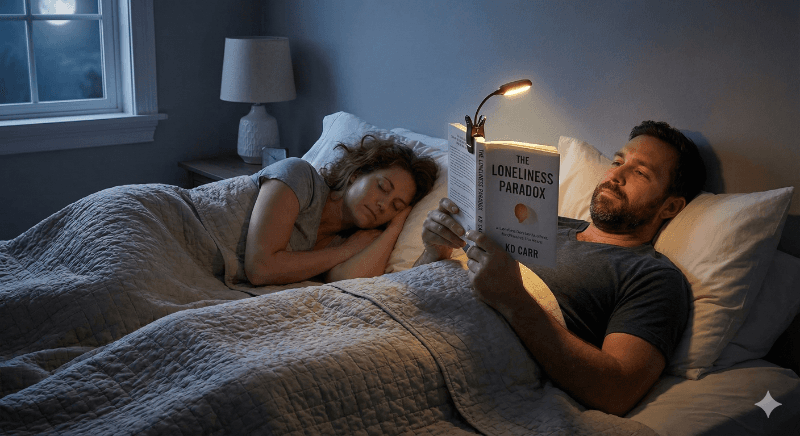
The first was The Loneliness Paradox by KD Carr. The core idea hit me like a truck: we are more connected than at any point in human history—more devices, more platforms, more ways to reach each other—and we are lonelier than we have ever been. Technology was supposed to solve isolation. Instead, it gave us the appearance of connection without the substance. A thousand online friends and no one to call at 2 AM.
The second was Loneliness: Human Nature and the Need for Social Connection by John T. Cacioppo and William Patrick. Cacioppo was a pioneer in social neuroscience—the study of how our brains process social connection. His work showed that loneliness isn't just an emotional state. It's a biological signal, like hunger or thirst. Your body is telling you that you need connection the same way it tells you that you need food. And when that need goes unmet, the consequences are physical, not just emotional.
Reading Cacioppo, I started to understand something I'd felt my entire life but never had language for: the loneliness I experienced wasn't a character flaw. It was my brain doing exactly what brains are supposed to do—alerting me that a fundamental human need wasn't being met.
The Rabbit Hole
After those two books, I went looking for scholarly research. I figured I'd find a reasonable amount. Maybe a hundred studies. Maybe two hundred. Something manageable.
I found thousands.
Thousands of studies touching on loneliness. From every angle imaginable. Neuroscience. Psychology. Public health. Cardiology. Geriatrics. Workplace performance. Student retention. Immune function. Cognitive decline. The research wasn't just extensive—it was overwhelming. An entire field of science had been studying this crisis for decades, and the findings were devastating.
Here's what I learned:
Loneliness increases your risk of premature death by 26%. Social isolation increases it by 29%. The Surgeon General compared the health impact to smoking up to 15 cigarettes a day—and that's not hyperbole. It's based on data from 148 independent studies involving over 300,000 people.
It increases your risk of heart disease by 29%. Stroke by 32%. It's linked to a 50% increased risk of developing dementia. 81% of lonely adults report experiencing anxiety or depression. And lonely workers cost employers an estimated $154 billion annually in stress-related absenteeism alone.
I set up news feeds to track articles about loneliness, expecting to find a handful per week. Instead, my inbox was flooded. Major outlets—not just academic journals—were running stories constantly. Everyone was talking about this. And yet, as far as I could tell, nobody was building the thing that could actually help.
Social media wasn't the answer—it was part of the problem. Dating apps only solved one kind of connection. Therapy addressed the symptoms but not the structural cause. Meetup groups worked for some people but required the kind of social initiative that lonely people, by definition, struggle with.
There was a gap. A massive, obvious, aching gap between the size of this crisis and the solutions that existed.
The Wordscapes Epiphany
While I was drowning in research, real life handed me a clue about what the solution might look like.
I play Wordscapes—one of those mobile games where you join a team and compete in tournaments. Our team was good. Really good. Everyone had to hit a minimum number of points or you'd get dropped. I'd check the chat occasionally, throw in a quick "good job" or "nice game," but I didn't participate much beyond that.
But here's what I noticed: there were always the same 10 to 15 people in that chat. And they weren't just talking about the game.
They were sharing stories from their lives. Someone just became a grandma for the first time. Someone else was having a rough week. People were being vulnerable with complete strangers, hiding behind usernames, with no idea if they were talking to a man or a woman, someone young or someone old. Some seemed lonelier than others. But all of them kept showing up, day after day, chatting with people they'd never met and would probably never meet.
They were longing for connection. And this random game chat was the closest thing they had to it.
I started asking around. Friends, family, anyone who'd listen. "Do you play any team games on your phone? Have you noticed the chat?" Everyone had a version of the same story. Royal Clash. Backgammon apps. Puzzle games. Different games, same pattern—a small group of people using the chat as a lifeline.
Then I asked my sister.
Now, my sister and I are very close. She's not just a sister—she's one of my best friends. So when she told me she played on a team, I wasn't surprised. But when she told me she was the team leader? That she was the one responsible for making sure everyone participated, that she kicked people off if they didn't contribute?
I was blown away. My sister—all-out team leader, running the show, managing a group of strangers through a mobile game. I had no idea.
And that's when the idea took shape: what if I could build a platform that turned these anonymous, accidental connections into real ones?
The Idea That Didn't Work (And the One That Did)
My first instinct was to build a gaming platform. Real connections through real games, but without the anonymity wall. People playing together and actually getting to know each other.
The problem was immediately obvious. The games at the top of the app store are there because massive companies with massive budgets built them. I wasn't going to out-Wordscapes Wordscapes. I'd have to convince people to play games without anonymity on a platform nobody had heard of, featuring games that competed with titles backed by millions in development. That wasn't a long shot—it was a moonshot.
But the insight underneath the gaming idea was solid: people are already reaching out to strangers online, craving connection, forming bonds in the most unlikely places. They just need a better structure for making those connections real.
So I stripped away the gaming platform. I stripped away the movie watch parties I'd briefly considered. I stripped away everything that was expensive, complicated, or already being done by someone else.
And what was left was the core: an AI companion who gets to know you well enough to help you find real friends. Not a social media platform. Not a dating app. Not a game. Something entirely new—an AI that uses the one thing technology has never been good at, genuine understanding of who you are, to facilitate the one thing humans need most.
kAI.
The Number That Wouldn't Leave Me Alone
Here's the thing about immersing yourself in loneliness research when you've been lonely your entire life: the data stops being abstract very fast.
Every statistic was a mirror. The friendship recession—Americans reporting three or fewer close friends jumping from 27% in 1990 to nearly 50% by 2021—that was me, staring at two friends at my wedding. Young adults spending 70% less time with friends in person than they did in 2003—that was me at the University of Oregon, sitting at the bar because I didn't know where else to go. The fact that loneliness hits every generation, every demographic, every income level—that was my aunt in her retirement community, eating dinner at a table with the same three people because no one knew how to make a new introduction.
This wasn't just a business opportunity. I want to be clear about that. Yes, I was starting to see that the market was enormous and the solutions were inadequate. Yes, I was thinking about this as a company. But the fire underneath all of it was personal. I could have spent the rest of my career doing financial consulting and been fine. Comfortable. Successful enough.
But I'd read too much. I'd seen too many numbers. And I couldn't stop thinking about the one that wouldn't leave me alone:
The health impact of loneliness is equivalent to smoking 15 cigarettes a day.
We banned cigarette advertising. We put warning labels on packages. We spent billions on cessation programs. We treated smoking like the public health crisis it was.
Loneliness is just as deadly. And nobody is treating it like a crisis. Nobody is building the tools to address it at scale.
I decided I would.
Paula saw me reading about loneliness constantly that year. She thought it was just a new interest—another thing I was diving into, the way I dive into everything. I wouldn't tell her my real plan until I knew it was something I could actually build. Something real. That moment would come a few months later, after Matt showed me what AI could do.
But the mission was already locked in. The research made it unignorable. And the kid who spent his whole life eating lunch on the wall finally had the data to prove it wasn't just him.
What Comes Next
In my next post, I'm going to introduce you to my team. All ten of them. They're all named Claude, they never call in sick, and their combined salary is less than what most people spend on streaming subscriptions. It's the story of how a solo founder with no technical background ended up with a full development operation—and what that means for anyone who's ever had an idea but couldn't find someone to build it.
But this post was about the research itself. The rabbit hole that turned personal pain into a mission, a mission into a market insight, and a market insight into a company called Kenektic.
150 million Americans feel lonely. The equivalent of smoking 15 cigarettes a day. And the best solutions anyone had come up with were social media, therapy, and Meetup groups.
We can do better than that.
Have you experienced something similar? Have you ever discovered research about something you'd experienced personally—and had that moment where the data made it feel real in a way your own experience couldn't? Or have you noticed those accidental connections in game chats, online communities, or other unexpected places? I'd genuinely love to hear your story.
Kenektic is in development and will launch soon. If you want to be notified when we're ready, or if you want to share your story with me directly, reach out at hello@kenektic.com.
Coming Next: "My Entire Team Is a Guy Named Claude" — The reveal of who's actually building Kenektic.