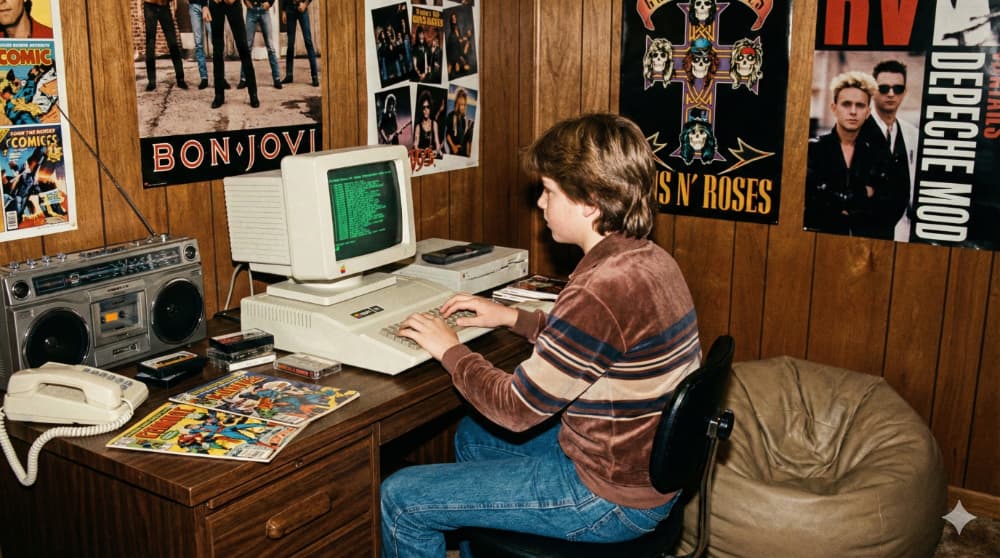
An Apple IIc, a Bar Mitzvah, and the Month I Learned to Code
The last time I wrote code before October 2025, I was thirteen years old, spending my Bar Mitzvah money on an Apple IIc.
I'd wanted a computer for as long as I could remember. While other kids were asking for bikes or skateboards, I was obsessing over the machines I'd seen in magazines and store displays. When my Bar Mitzvah finally came and the checks arrived, I knew exactly where every dollar was going.
The Apple IIc was beautiful. Compact. That satisfying mechanical keyboard. A green monochrome monitor that felt like a portal to another world. I set it up in my room and started teaching myself BASIC.
My First App Was Glorified Pong
I built a game. If you can call it that.
It was a vertical line on the left side of the screen that you controlled with the up and down arrow keys. A ball would bounce off the right side of the screen and come toward you, and your job was to block it with the line. That's it. That was the entire game.
Glorified Pong. One paddle. No opponent. No score. Just a line, a ball, and a thirteen-year-old kid who thought he was building the future.
I played around with it a lot. Tweaked the speed. Adjusted the angles. Tried to make it harder. But I never got much further than that one game.
The Strip Mall Coding Class
I wanted to get better, so I found a programming class. Not at school—this was a class at a strip mall somewhere, the kind of place that probably also offered karate lessons and tax preparation. The instructors didn't have much experience. The curriculum was thin. And I just couldn't take my programming to the next level.
Looking back, I think the problem was that coding in the early '80s was lonely work. There was no Stack Overflow to search. No YouTube tutorials. No AI to explain what you were doing wrong. Just you, a book, a blinking cursor, and nobody around who could help you figure out why your program wasn't working.
Sound familiar? A kid who wanted to connect, struggling because there was no structure to support him? The pattern shows up everywhere, doesn't it?
The Pivot I Didn't Know Was a Pivot
So coding faded. Pretty quickly, actually. No dramatic moment—I just stopped.
But here's what I did instead: I became an expert at using software. Not building it. Using it.
I mastered Lotus 1-2-3—the Excel of its era—when nobody I knew had even heard of spreadsheets. I was typing homework assignments in WordPerfect while my classmates were still handwriting theirs. I'd print everything out on my dot matrix printer, the one where you had to tear the perforated strips off the sides of the paper. If you're under 40, I promise I'm not making that up.
I loved numbers. I could build a spreadsheet that sang. And without realizing it, that combination—loving technology, mastering tools, being great with numbers—was steering me straight into finance.
The kid who wanted to be a programmer became a guy who was really good at using programs. Close, but not the same thing.
That gap between using and building would follow me for thirty years.
Fast Forward: October 2025
If you read my last post, you know what happened in September. Matt showed me the poker app. I saw what AI could do. I went home that same day and started.
For the first week or two, I used Cursor—the tool Matt had showed me. It worked. But something didn't quite click with how I learn.
Then I discovered a different approach. Instead of letting AI generate everything automatically, I started writing my own prompts, feeding them into Claude's desktop app, getting back detailed explanations and code, and then—here's the key—manually copying and pasting that code into VS Code myself.
This was definitely slower. The tech community would probably call it the "longcut." But slowing down was exactly what I needed. By taking each piece of code and moving it myself, I had to actually look at it. Understand what it was doing. Figure out how the pieces fit together. I wasn't just generating code—I was learning to read it.
For a guy who'd spent thirty years on the using side of technology, this was the bridge to the building side. And I needed to cross it at my own pace.
Kenekt Four (Because I'm That Witty)
The first real thing I built was a game I called Kenekt Four. Yes, like Connect Four. Yes, I thought that was hilarious.
I poured myself into it. Tried to make the AI opponent as tough as possible. Worked on the strategy, the difficulty levels, the logic. I was genuinely proud of it.
Then my youngest son sat down to play.
He beat it. Every time. This is the same kid who solves a Rubik's Cube in under a minute and picks up new subjects at a speed that makes the rest of us feel like we're moving through water. But still—I'd worked so hard on that AI opponent, and he was dismantling it without breaking a sweat.
I'd like to tell you I was frustrated, but honestly? I was thrilled. I'd built something real enough that my kid wanted to play it. That it worked at all felt like a miracle.
After Kenekt Four, I built a sports calendar app. You select your favorite teams and it compiles their entire season schedule into one calendar you can import through iCal. All your teams, all your games, one view. It's actually a fun little app—if you want it, drop me a note and I'll send it to you.
But these were warm-ups. The real thing was coming.
The First Iteration of Kenektic Was... Different
Here's something I haven't shared before: the original concept for Kenektic wasn't exactly what it is today.
My first idea was that you'd meet friends through kAI—that part stayed—but then the platform would include a gaming component. You know how in games like Wordscapes there are always those same ten people in the chat? People who play together every day, who joke around, who clearly enjoy each other's company but have no way to connect outside the game? I thought: what if I could introduce them to each other beyond the game?
Then I thought about watch parties—being able to watch movies together on the platform. But that's been done, and licensing the right technology for streaming is expensive and complicated. It was a distraction from the core mission.
So I stripped it down. And what was left was the thing that mattered most: kAI.
The Moment It Clicked
In the beginning, kAI was essentially just Claude Sonnet wearing a different name tag. A chatbot. Nothing special.
But then I realized something that changed everything: I could completely reshape how kAI spoke. I could define his personality. I could set guardrails. I could make him stay focused on friendship—not therapy, not medical advice, not financial planning. Just friendship.
That was the aha moment.
This is what I can do. Not build a game platform. Not license movie streaming. I can build something that doesn't exist yet: an AI companion whose entire purpose is to get to know you deeply enough to help you find real friends.
And I was clear about one thing from the start: kAI is not a therapist. I never wanted that. Building a mental health tool should be done by PhD programs, by people who are experts in psychology and machine learning. Could I build one? Probably. Would I want to? Absolutely not. I don't want kAI to be responsible for someone's mental health treatment.
What I want is for kAI to facilitate friendship—which, as it turns out, is one of the single greatest contributors to mental health. And physical health. The research is overwhelming on this. But I'm getting ahead of myself. That's a post for another day.
12-Hour Days
Once I knew what to build, I couldn't stop.
Twelve-hour days became normal. Fourteen-hour days weren't unusual. I was full-time on this—no side job, no "working on it evenings and weekends." This was it. Every day, all day.
I'd wake up, sit down at my computer, and build. Teaching kAI how to talk. How to listen. How to steer conversations toward connection without being pushy. How to remember what you told him and bring it back naturally. How to be warm without being fake. How to be helpful without being clinical.
It's harder than it sounds. Getting an AI to feel like a friend instead of a tool requires thousands of small decisions. What does kAI say when someone shares something painful? How does he respond to humor? When does he ask a follow-up question versus just listening? How does he handle someone who's testing his boundaries?
Every one of those decisions required building, testing, adjusting, rebuilding. Over and over. Day after day.
My Family Figured It Out
By late October, there was no hiding it anymore.
My wife and kids could see something had taken over. I was at my computer every single day, clearly in the grip of something. The Kenekt Four episode had given them a preview. My youngest son's inability to lose at it had given them something to tease me about.
But what surprised me was the support. My family wasn't just tolerant of what I was doing—they were impressed. They could see me learning at a pace that didn't seem possible. Picking up concepts that should have taken months in days. Building things that actually worked.
I don't think they fully understood what Kenektic would become yet. Honestly, I didn't either. But they could see that whatever this was, it was real, and it was moving fast.
The Bridge I'd Been Looking For
Here's what I want you to understand about October 2025:
For thirty years, I'd been on one side of a gap. I loved technology. I was great at using it. I could master any software application you put in front of me. But building? Creating? Writing the code that makes the tools work? That was the other side. And every time I'd tried to cross—the Apple IIc, the strip mall class, the years of fintech ideas that stayed ideas because I couldn't answer the question "who builds it?"—I'd fallen short.
AI didn't magically make me a programmer. I want to be honest about that. I still struggle with concepts. I still break things. I still have days where error messages make me feel like I'm thirteen again, staring at a blinking cursor with no one to help.
But AI did something equally important: it met me where I was. It let me take the longcut. It explained things when I didn't understand. It didn't judge me for asking basic questions. It didn't care that I was a finance guy who hadn't coded since BASIC on an Apple IIc.
It just helped. Patiently. Tirelessly. Every day.
And somewhere in October, I crossed the bridge.
What Comes Next
In my next post, I'll tell you about the discovery that supercharged everything—the moment I figured out how to use Claude as both my project manager and my developer at the same time. Two different tools, two different roles, one AI brain. It's the workflow that let a non-coder build a production platform, and it's something I don't think most people know is possible.
But this post was about something simpler than workflow innovation. It was about a kid who spent his Bar Mitzvah money on an Apple IIc, couldn't get past Pong, walked away from coding for three decades, and then found his way back because the technology finally caught up with the dream.
The kid with the Apple IIc would be stunned.
And I'm just getting started.
Have you experienced something similar? Did you ever love something, walk away from it, and find your way back years later? Did technology open a door that used to be closed? I'd genuinely love to hear your story.
Kenektic is in development and will launch soon. If you want to be notified when we're ready, or if you want to share your story with me directly, reach out at hello@kenektic.com.
Coming Next: "My Secret Weapon: Using Claude as Both PM and Developer" — The workflow discovery that changed what a solo founder could build.