A Retirement Home Visit Changed Everything
In my last post, I told you about the kid who ate lunch on a wall in seventh grade. About the college student who sat alone on a barstool while his one friend worked the room. About the guy who looked around his wedding and realized how small his world had become despite decades of trying.
That was my story. I'd carried it for decades. But it was still just my story—a private thing I'd learned to live with, the way you learn to live with a bad knee or a scar you don't show people.
What turned it from something I carried into something I had to fix was watching my aunt live it at 80.
Her Building Had 200 Residents. She Knew Maybe Ten.
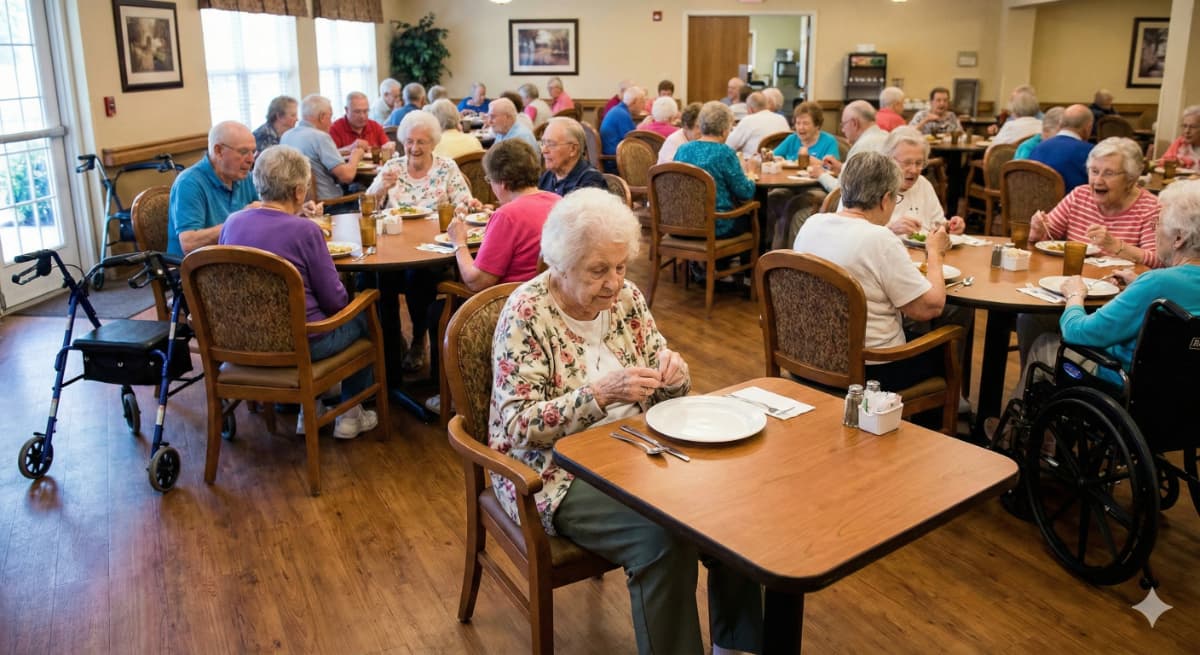
My aunt moved into a retirement community a few years ago. Nice place. Well-run. Activities calendar on the wall. Common rooms with big TVs. A dining hall where residents gathered every evening.
On paper, it was everything you'd want for someone entering that chapter of life. Community. Neighbors. Shared meals. Structure.
In reality, she knew the people at her dinner table and the women in her mahjong group. That was it. Maybe ten people out of two hundred.
Not because she was difficult or unlikable. She was warm, funny, opinionated—the kind of person who, once you got to know her, you genuinely wanted around. But getting to know her required someone making that first move. And in a retirement community, just like in a seventh-grade cafeteria, nobody's lining up to make the first move.
Invisible Connections Everywhere
The more I visited, the more I saw it. Not just her loneliness, but the architecture of it. The way the building was full of connections that should have existed but didn't.
The dining hall had settled into patterns. Groups of four or six who'd been sitting together since before she arrived. Every chair taken. Every table claimed. Not by malice—just by habit. No open seat. No natural entry point. No one saying, "Hey, come sit with us." Not because they wouldn't have welcomed her—but because they didn't know she was looking.
She's a Dodgers fan. Not casual—she actually watches the games. But West Coast baseball means first pitch at 7:10, and most nights the game doesn't end until close to 10. By 8:30, the common room is empty. So she'd watch alone, in her room, in a building with two hundred other people. And I kept thinking: there have to be other Dodgers fans in this building. People who'd love to watch a game together, who'd be happy to stay up a little later if they had someone to stay up with. But how would she ever find them? No one's going door to door asking.
My aunt also lived with bipolar disorder. She managed it—had for years—but it was part of her life. In a community of two hundred people, there had to be others dealing with mental health challenges. People who might benefit from even an informal support network. But you can't exactly post a flyer in the elevator. The stigma alone would keep most people away.
And those were just the connections I could see. What about the veteran down the hall who'd love to meet another veteran? The retired teacher who misses intellectual conversation? The woman who knits alone in her room and doesn't know that three other residents knit too?
Every one of those invisible connections represents two people who are lonelier than they need to be.
The Mirror
I'd sit there visiting my aunt, listening to her describe her days—mahjong on Tuesdays, dinner with the same four people, Dodger games alone in her room—and I'd feel something tighten in my chest.
Because I recognized it. All of it.
The dinner table with no open seat? That was the lunch table I couldn't sit at in seventh grade.
The common room that emptied out before the game started? That was the barstool I sat on in college while everyone else connected around me.
The two hundred residents who could have been friends but had no way to find each other? That was the University of Oregon. Thousands of students. One real friend.
My aunt wasn't reliving my childhood. She was living proof that the pattern never stops. That the same forces that make it hard to connect at 13 make it hard to connect at 80. That loneliness doesn't age out, doesn't resolve itself, doesn't get easier just because you've had more practice at life.
The only difference between seventh-grade me and my aunt was decades. The wall was the same.
The Realization That Changed Everything
Here's what made this more than recognition. More than "this is sad, this is familiar."
My aunt's situation wasn't about a personal failing. She wasn't bad at friendship the way I'd always told myself I was bad at friendship. She was perfectly capable of connecting—she proved that with her dinner group and her mahjong friends. The problem was structural. The system around her had no mechanism for discovering compatibility, no way to surface shared interests, no tool for making that critical first introduction.
And that reframed my entire life.
Maybe I hadn't been bad at friendship all those years. Maybe I'd been stuck in environments that had no mechanism for helping people like me find each other. No one at Oregon was going to tap me on the shoulder at that bar and say, "Hey, there's a guy who's into the same things you are—you two should talk." No one at USC was going to pull me aside and say, "There are three other people here who are struggling with the same things you are."
The introductions never happened. Not because they couldn't. Because nothing existed to make them happen.
My aunt didn't need to become more outgoing. She needed someone—or something—to say: "There's a woman on the third floor who also watches the Dodgers. She's also up at 9:30. Want me to introduce you?"
That's it. That's the whole thing.
And here's what made it urgent: the clock is running. At 25, you can tell yourself you'll figure out the friendship thing eventually. At 80, "eventually" isn't really on the table anymore. Every day my aunt watched the Dodgers alone was a day she didn't get back.
I stopped thinking "I wish someone would solve this" and started thinking "I have to solve this."
The Idea Got Bigger Than One Building
At first I was thinking about my aunt's building. Two hundred residents. Invisible connections. That was problem enough.
But the loneliness epidemic isn't really an older adult problem. It's a human problem. Young adults are actually among the loneliest demographics in the country, probably because the structures that used to produce friendships—school, shared physical space, extended time together—have eroded faster for them than anyone else. Middle-aged adults who've lost their work friendships after a job change. New parents whose old social circles no longer fit their lives. People who moved for a relationship that ended, or a job that didn't work out, and found themselves in a new city with no one.
And the connections didn't have to be limited by who happened to live down the hall. What about the Dodgers fan three towns over who'd have loved to watch a late game with my aunt? What about the person in another state who shared her exact sense of humor, her love of mahjong, her particular way of seeing the world?
But how do you find those people?
Not with a questionnaire. You don't discover who someone really is by asking them to check boxes. People don't even know how to describe themselves accurately in that format. They tell you who they think they should be, not who they actually are.
What you'd need is something—someone—you could actually talk to. Someone you could open up to over time. Not in one sitting, not in a personality quiz, but gradually, the way you open up to a real friend. Someone who would never judge you. Someone whose whole purpose was singular: to get to know you well enough to help you find your people.
Real people. In small groups. People you'd be personally introduced to—not thrown into a feed with, not matched with based on a photo and a three-line bio, not left to figure it out on your own in a room of strangers.
No follower counts. No likes. No algorithms designed to keep you scrolling. No swiping. No romantic pressure. No performance.
Just small groups of people who genuinely understand each other, brought together by something that took the time to learn who they really are.
A friend-finder that actually knows you first.
I didn't know what to call that something yet. I didn't know if it was technically possible. But I knew exactly what it needed to do:
Walk up to the wall and say, "Hey, there's someone I think you should meet."
Pull up a chair at the full table and say, "I found you a seat."
Tell the woman watching the Dodgers alone, "There's someone who's also watching. Want me to connect you?"
I'd later name that something kAI. But I'm getting ahead of myself.
What Comes Next
In my next post, I'll tell you about the moment I realized I could actually build this thing. It involves my best friend, a poker app, and a conversation over lunch that changed the trajectory of my life. It also involves an Apple IIc computer, a glorified version of Pong, and the realization that the last time I wrote code, I was spending my Bar Mitzvah money.
But that's a story for next time.
For now, I want you to sit with this: somewhere right now, in a retirement community or a college dorm or a corporate office or a suburban neighborhood, there's someone who could be your friend. Someone who gets you. Someone who shares the things that actually matter—not just the surface stuff, but the real stuff.
You'll never meet them. Because there's no empty chair. No introduction. No one to say, "Hey, I think you two should talk."
Not yet, anyway.
That's the problem I'm solving. And after visiting my aunt, I knew I couldn't wait any longer.
Does this resonate with you? Have you ever watched someone you love struggle with loneliness—a parent, a grandparent, a friend? I'd genuinely love to hear your story.
Kenektic is in development and will launch soon. If you want to be notified when we're ready, or if you want to share your story with me directly, reach out at hello@kenektic.com.
Coming Next: "How a Poker App Convinced Me I Could Code (Spoiler: I Couldn't)" — The friend, the demo, and the lunch that started everything.